Dynamic Capabilities
What they are, why they decide who adapts and who does not, and a self-assessment to find out whether you have them.
Where it fitsStage 1 of 7 · Diagnose: Where are we, and what is the real problem?
What it is
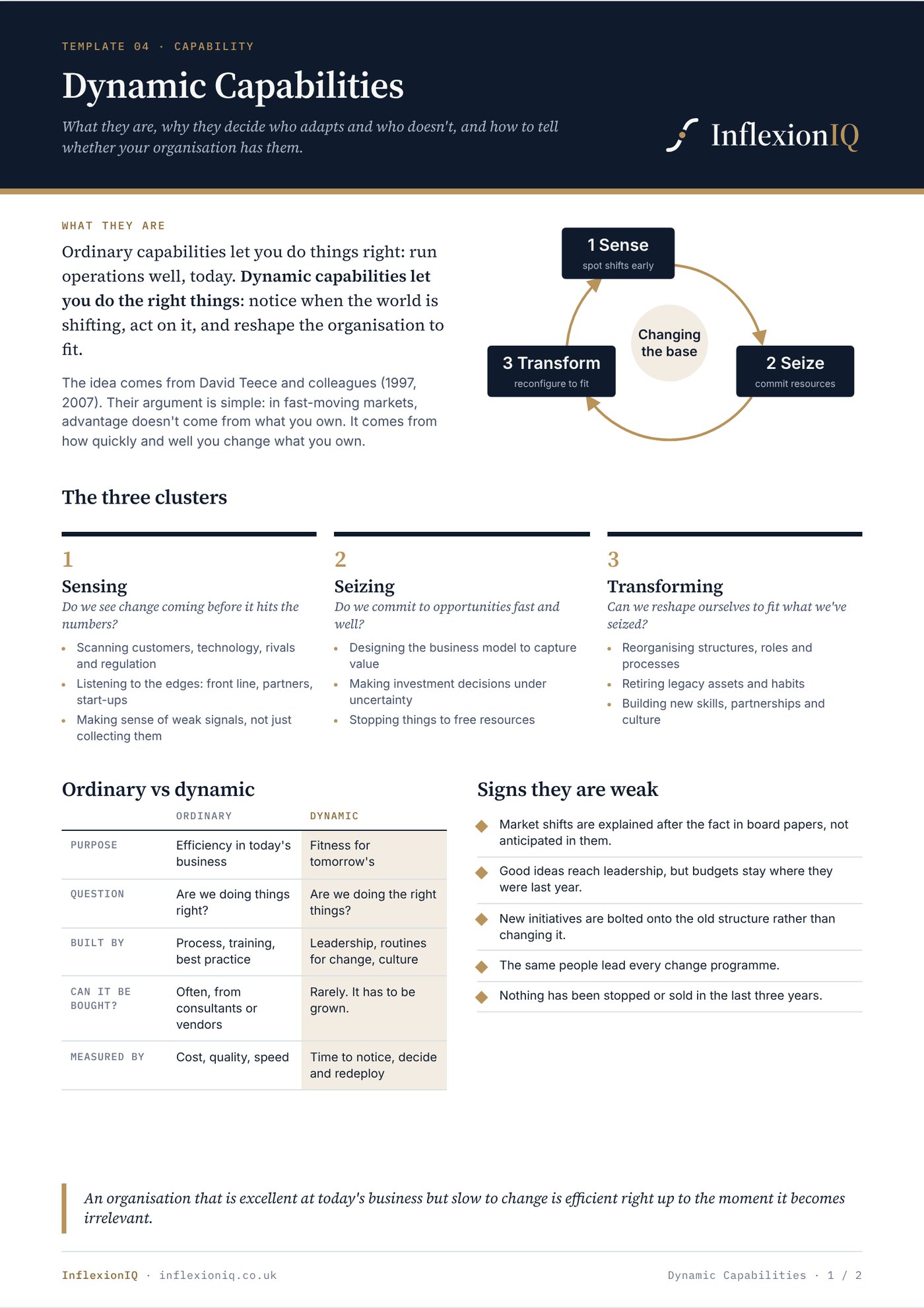
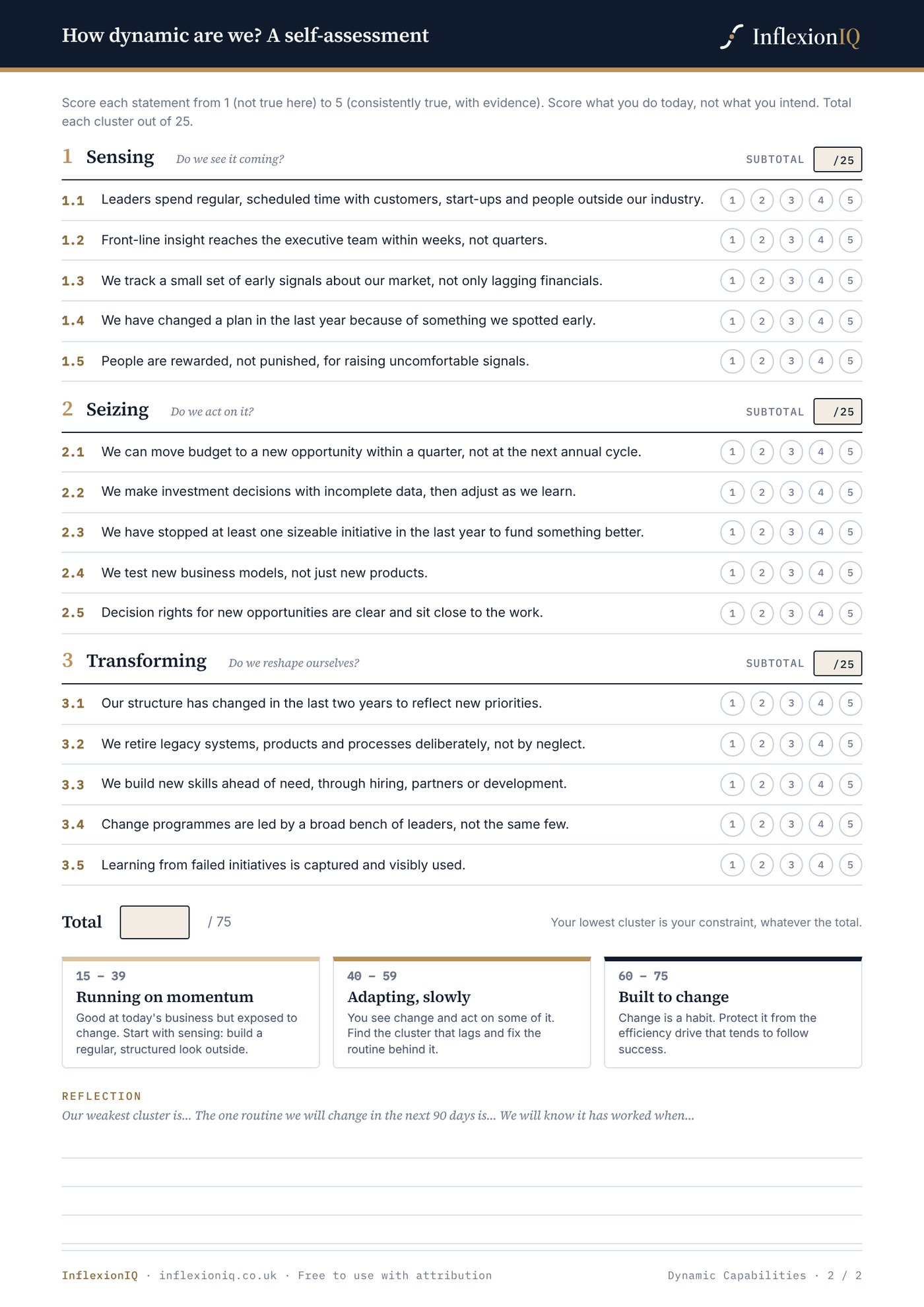
A short explainer and a self-assessment. The explainer covers the three clusters of dynamic capabilities, sensing, seizing and transforming, along with how they differ from ordinary capabilities and the signs they are weak. The self-assessment has 15 statements, five per cluster. The Excel version calculates your score, your band and the cluster holding you back, and has a team tab that flags where people disagree.
Why use it
Ordinary capabilities let you do things right today. Dynamic capabilities let you notice when the world shifts, act on it and reshape the organisation to fit. In fast-moving markets they decide who adapts, yet few organisations ever measure them. The self- assessment gives a leadership team a shared, honest picture in under half an hour.
How to use it
- Read the explainer together so everyone shares the same language: sensing, seizing and transforming.
- Have each leader complete the self-assessment on their own before the meeting. Honest answers matter more than high scores.
- Use the team tab in Excel to compare scores. The gaps between people are often more revealing than the averages.
- Discuss the lowest-scoring cluster and agree two or three practical changes, each with an owner.
- Repeat the assessment in six to twelve months to see whether anything has moved.
When it helps
- Before a strategy refresh or a transformation
- When the business keeps reacting to change instead of seeing it coming
- As a leadership team development exercise
- To compare how different units or teams see the organisation
What is inside
- A one-page explainer with the sense, seize, transform model
- Ordinary vs dynamic capabilities, side by side
- A 15-statement self-assessment with three result bands
- In Excel, automatic scoring and a team comparison for up to six people
Worked example
Nine executives completed the self-assessment separately, then compared their scores in a two-hour session.
| Sensing: 3.6 out of 5 | Good. Brokers and the risk team spot market changes early. |
|---|---|
| Seizing: 2.2 out of 5 | Weak. A new idea takes six months to get through the change board. |
| Transforming: 2.0 out of 5 | Weak. The last systems change ran a year late, and processes were never redesigned. |
| Widest gap | The CEO scored seizing at 4. Heads of department scored it at 2. |
| Agreed actions | A monthly investment panel for small tests, with decisions in four weeks. One accountable sponsor for each change. |
What happened next. The faster panel is how the AI document-checking test got funded within a month.
Preview
Questions
What are dynamic capabilities?
An organisation's ability to sense changes in its environment, seize the opportunities they create and transform its resources and structure to fit. The idea was developed by David Teece and colleagues.
What is the difference between ordinary and dynamic capabilities?
Ordinary capabilities make today's business efficient: doing things right. Dynamic capabilities keep the business fit for the future: doing the right things, and changing when the world does.
Rate and review
How useful was this template?
Your rating and comments help me improve the template and decide what to build next. It takes less than a minute.
Thank you.
Your feedback has been sent. If you have got another minute, share the template with someone who'd find it useful.
More templates
All templates →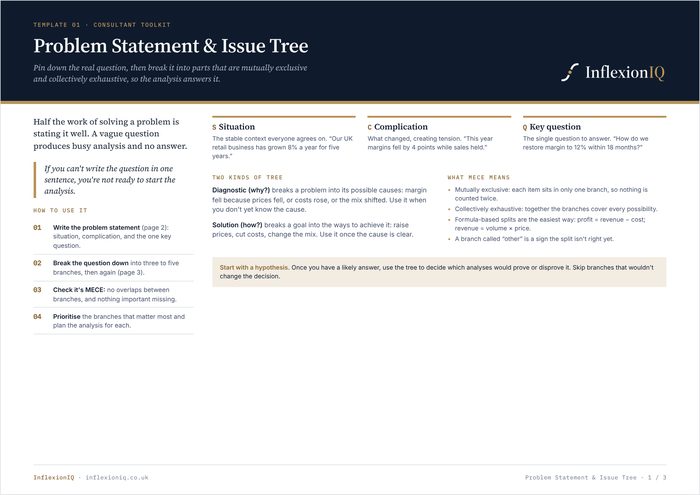
Problem Statement & Issue Tree
Pin down the real question, then break it into parts that are mutually exclusive and collectively exhaustive, so the analysis answers it. PowerPointPDFView and download →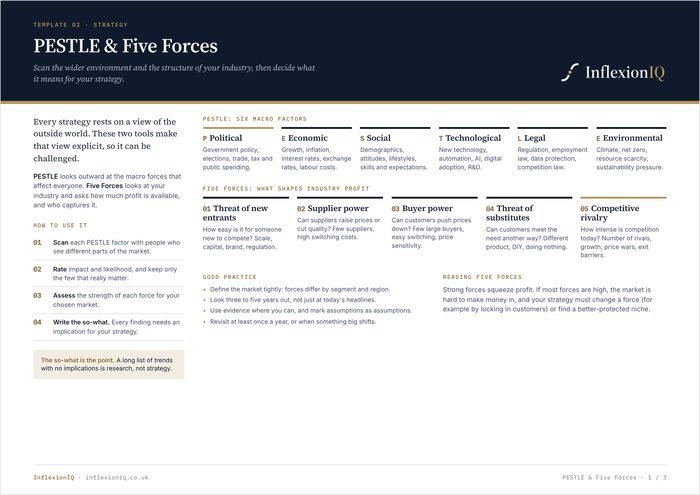
PESTLE & Five Forces
Scan the wider environment and the structure of your industry, then decide what it means for your strategy. PowerPointExcelPDFView and download →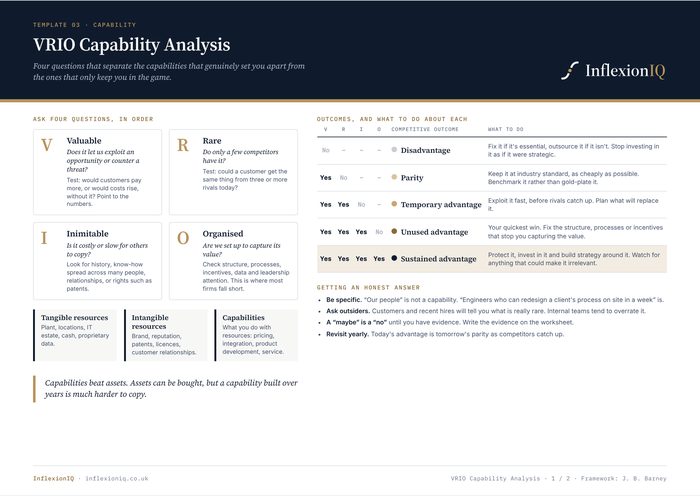
VRIO Capability Analysis
Four questions that separate the capabilities that set you apart from the ones that only keep you in the game. ExcelPDFView and download →Need something different? Request a template →