Value Proposition Canvas
Design products and services around what customers are trying to get done, what frustrates them and what they hope for.
Where it fitsStage 3 of 7 · Design: What must the organisation and the offer look like?
What it is
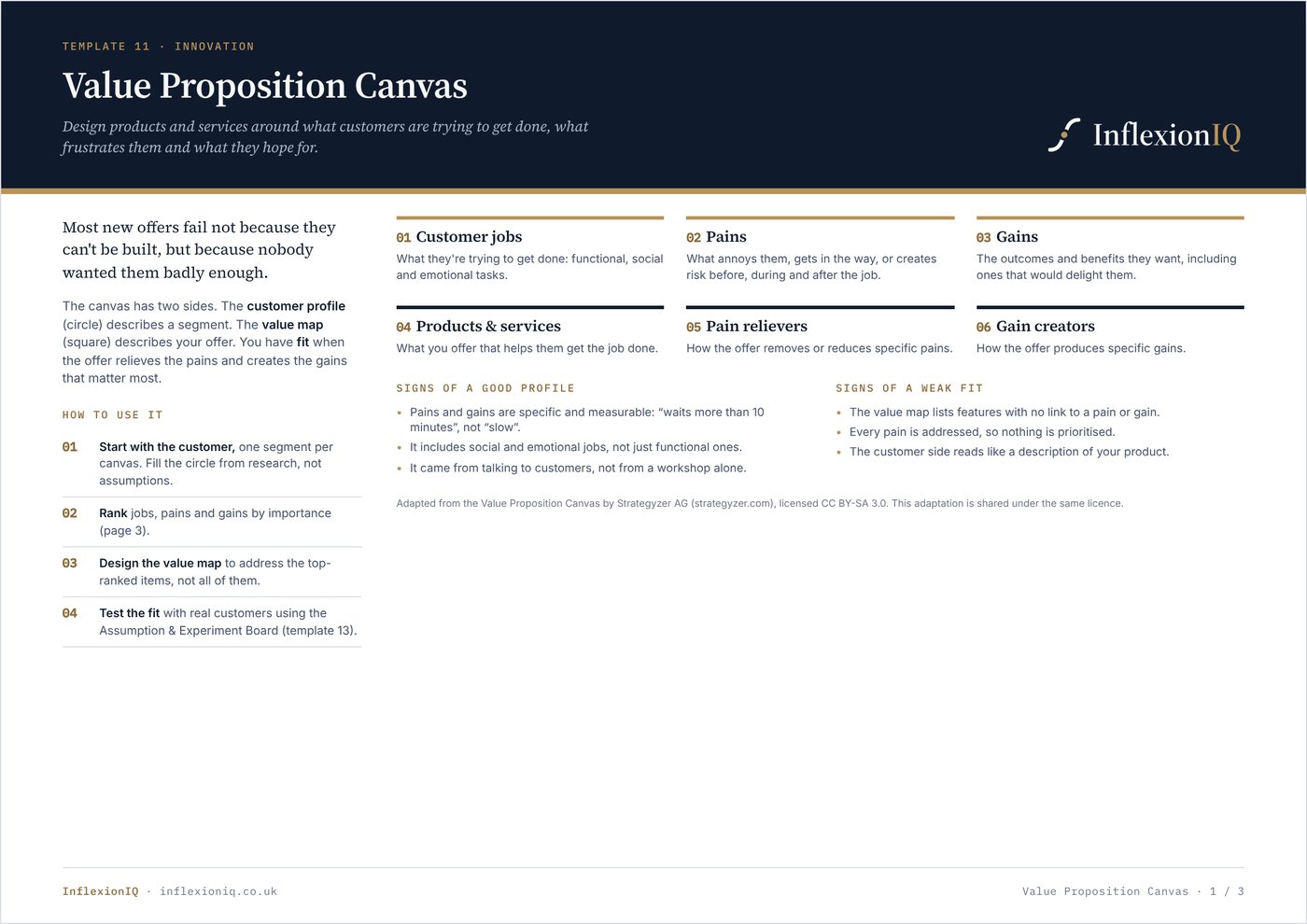
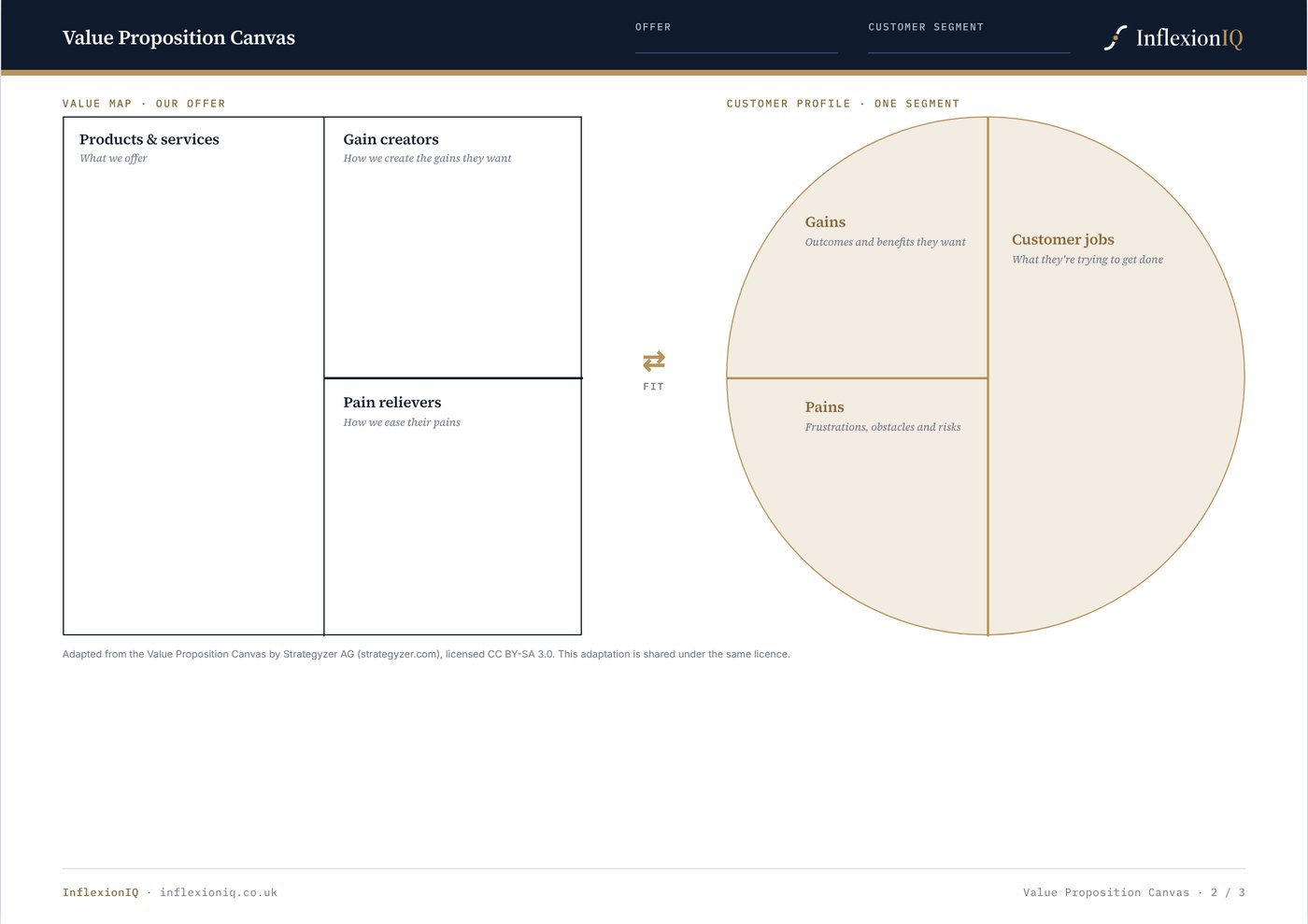
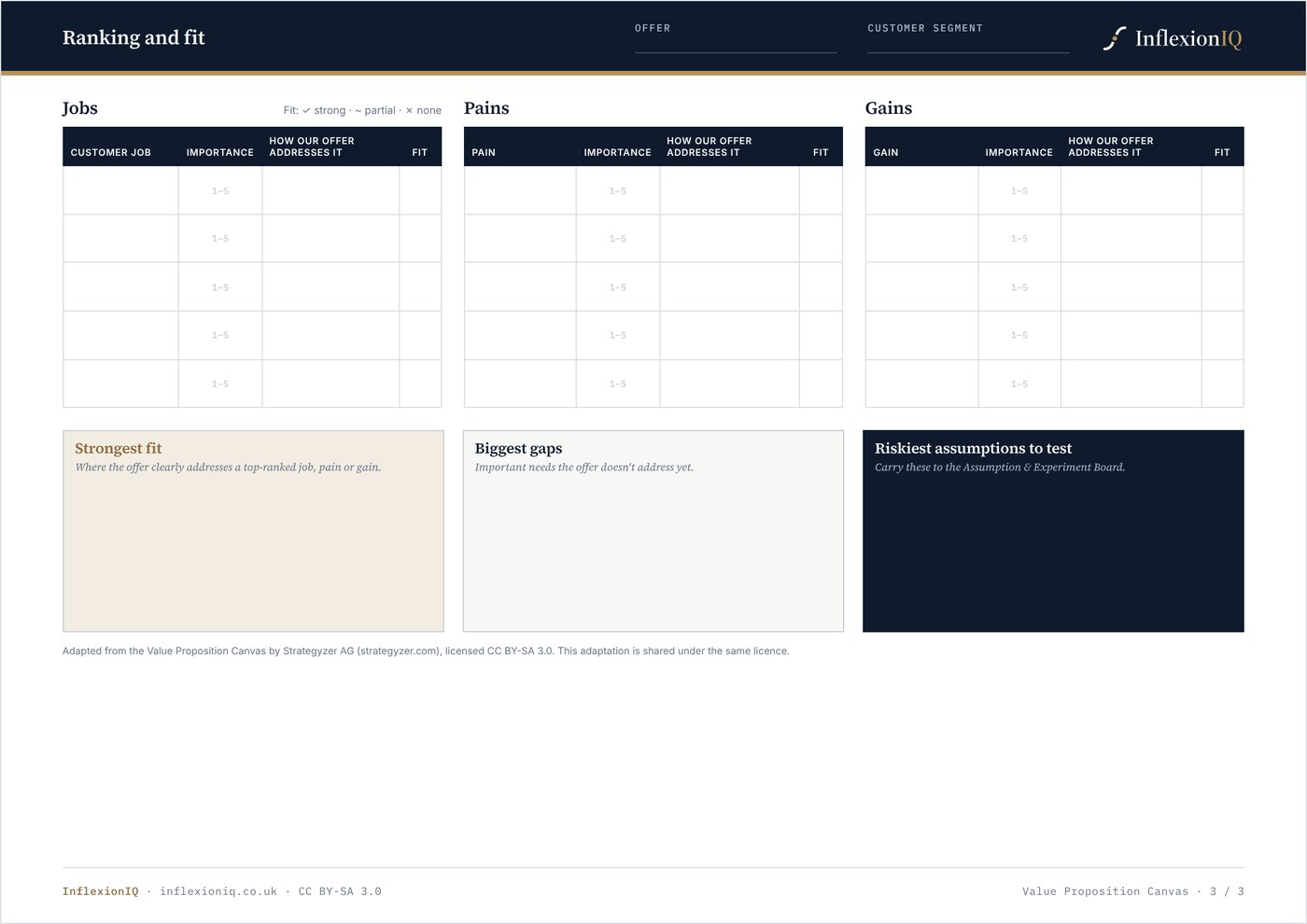
A branded, editable version of the Value Proposition Canvas. The guide explains the six blocks and how to fill them from research. The canvas page holds the customer profile and the value map. A third page ranks jobs, pains and gains by importance and checks which ones your offer actually addresses.
Why use it
New products and services rarely fail because they cannot be built. They fail because customers did not want them enough. The canvas starts with the customer and shows quickly whether your offer solves a problem that matters to them.
How to use it
- Choose one customer segment. Use a separate canvas for each segment.
- Fill the circle from research, not assumptions: the jobs customers are trying to do, their pains and the gains they want.
- Rank the jobs, pains and gains by importance on page 3.
- Design the square to address the top-ranked items: products and services, pain relievers and gain creators.
- Check the fit, then test the riskiest parts with real customers using the Assumption & Experiment Board.
When it helps
- Designing a new product, service or customer experience
- Redesigning an offer that is not selling
- Turning customer research into design choices
- Preparing experiments to test demand
What is inside
- A guide to the six blocks and the signs of a good profile
- The canvas, with customer profile and value map
- A ranking and fit check for jobs, pains and gains
Worked example
The lender's fastest-growing segment is self-employed people buying a home through a broker. The team interviewed 20 of them and 10 brokers.
| Customer job | Get a mortgage approved when your income varies from year to year. |
|---|---|
| Top pain | Being asked for the same documents again and again, then waiting three weeks without news. |
| Top gain | Knowing early, and for sure, how much they can borrow. |
| Pain reliever | Upload documents once. AI checks them the same day, and a named underwriter calls if anything is unclear. |
| Gain creator | A decision in principle within 24 hours, backed by a real underwriter. |
| Fit | Strong on speed and certainty. Weaker on staying in touch after the offer, which became a later idea. |
What happened next. Brokers said they would send more self-employed cases if decisions came within a week.
Preview
The Value Proposition Canvas is by Strategyzer AG (strategyzer.com) and is shared under a Creative Commons Attribution-ShareAlike 3.0 licence. This branded version is shared under the same licence.
Questions
What are the two sides of the Value Proposition Canvas?
The customer profile (the circle) describes a segment's jobs, pains and gains. The value map (the square) describes your products and services, pain relievers and gain creators. You have fit when the square addresses what matters most in the circle.
How many customer segments go on one canvas?
One. Different segments have different jobs, pains and gains, so blending them hides the real design choices. Use a separate canvas for each.
Rate and review
How useful was this template?
Your rating and comments help me improve the template and decide what to build next. It takes less than a minute.
Thank you.
Your feedback has been sent. If you have got another minute, share the template with someone who'd find it useful.
More templates
All templates →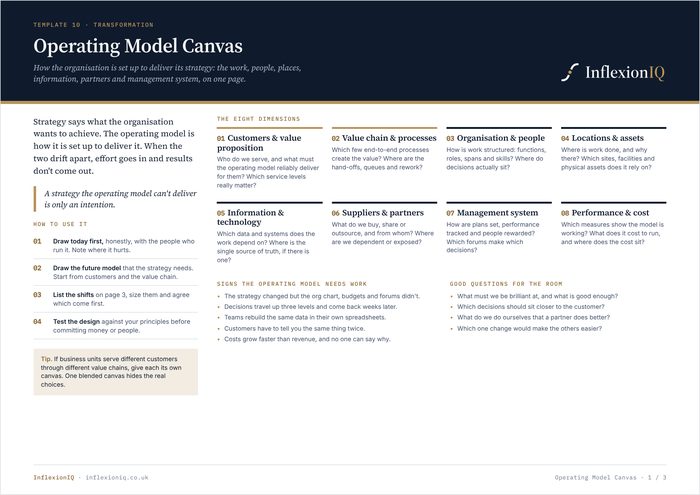
Operating Model Canvas
How the organisation is set up to deliver its strategy, from the work and people to places, information, partners and management, on one page. PowerPointPDFView and download →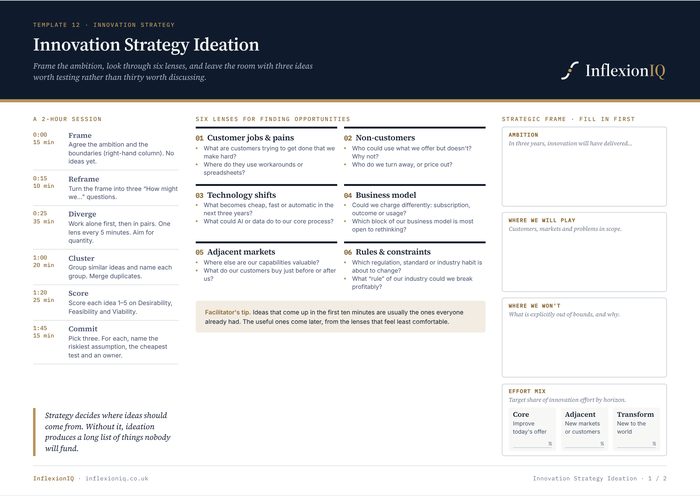
Innovation Strategy Ideation
Frame the ambition, look through six lenses, and leave the room with three ideas worth testing. PowerPointPDFView and download →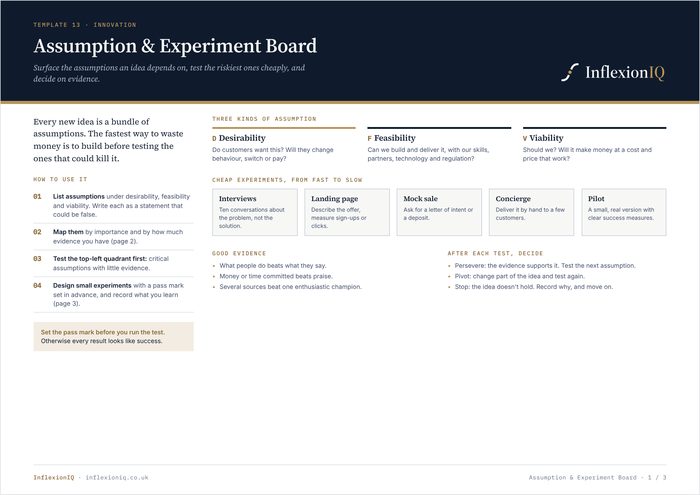
Assumption & Experiment Board
Surface the assumptions an idea depends on, test the riskiest ones cheaply, and decide on evidence. PowerPointPDFView and download →Need something different? Request a template →