Business Case & NPV
Make the case for an investment, from the problem and the options to the value they create in today's money and how it will be delivered.
Where it fitsStage 4 of 7 · Prioritise & fund: What do we do first, and is it worth it?
What it is
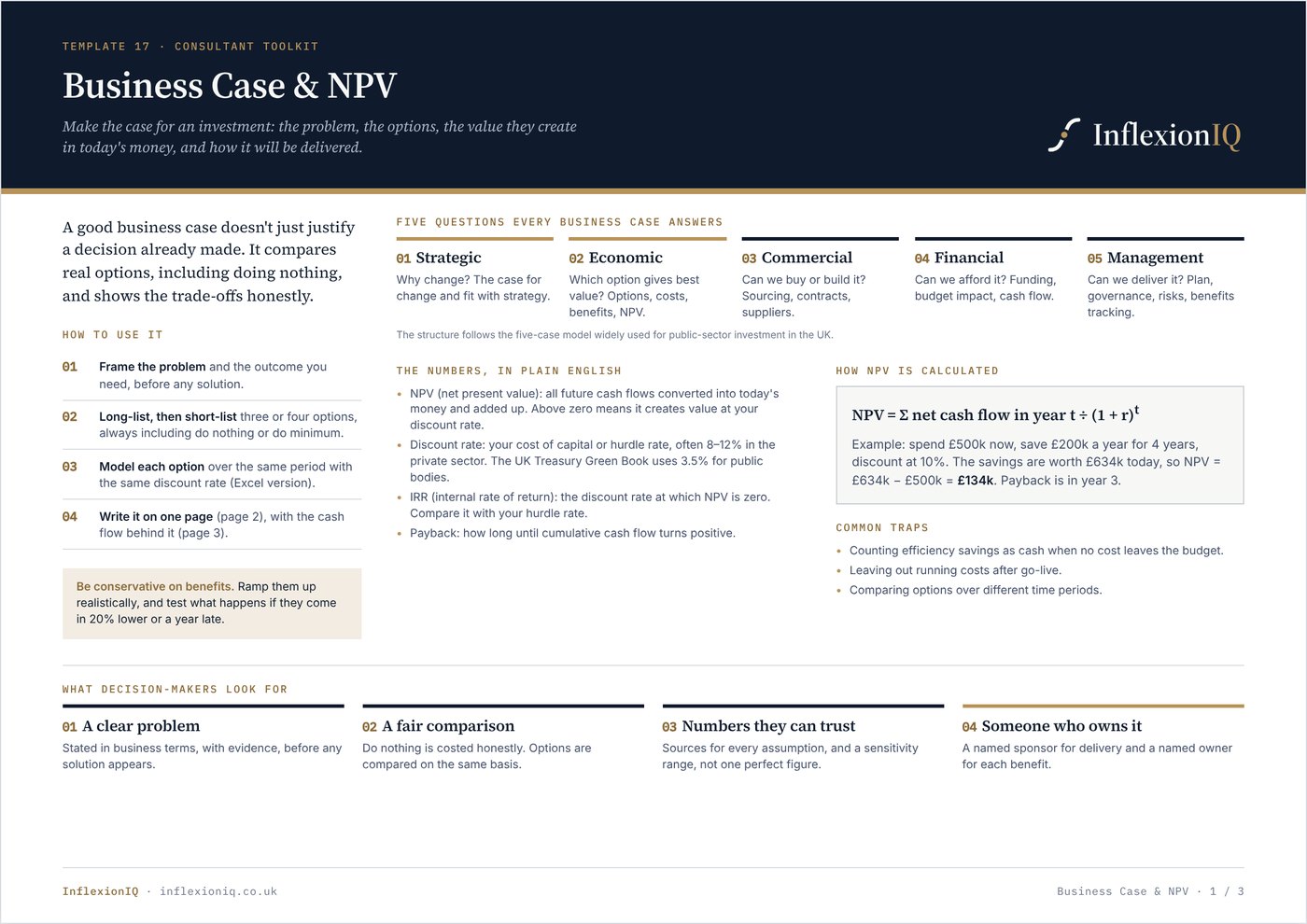
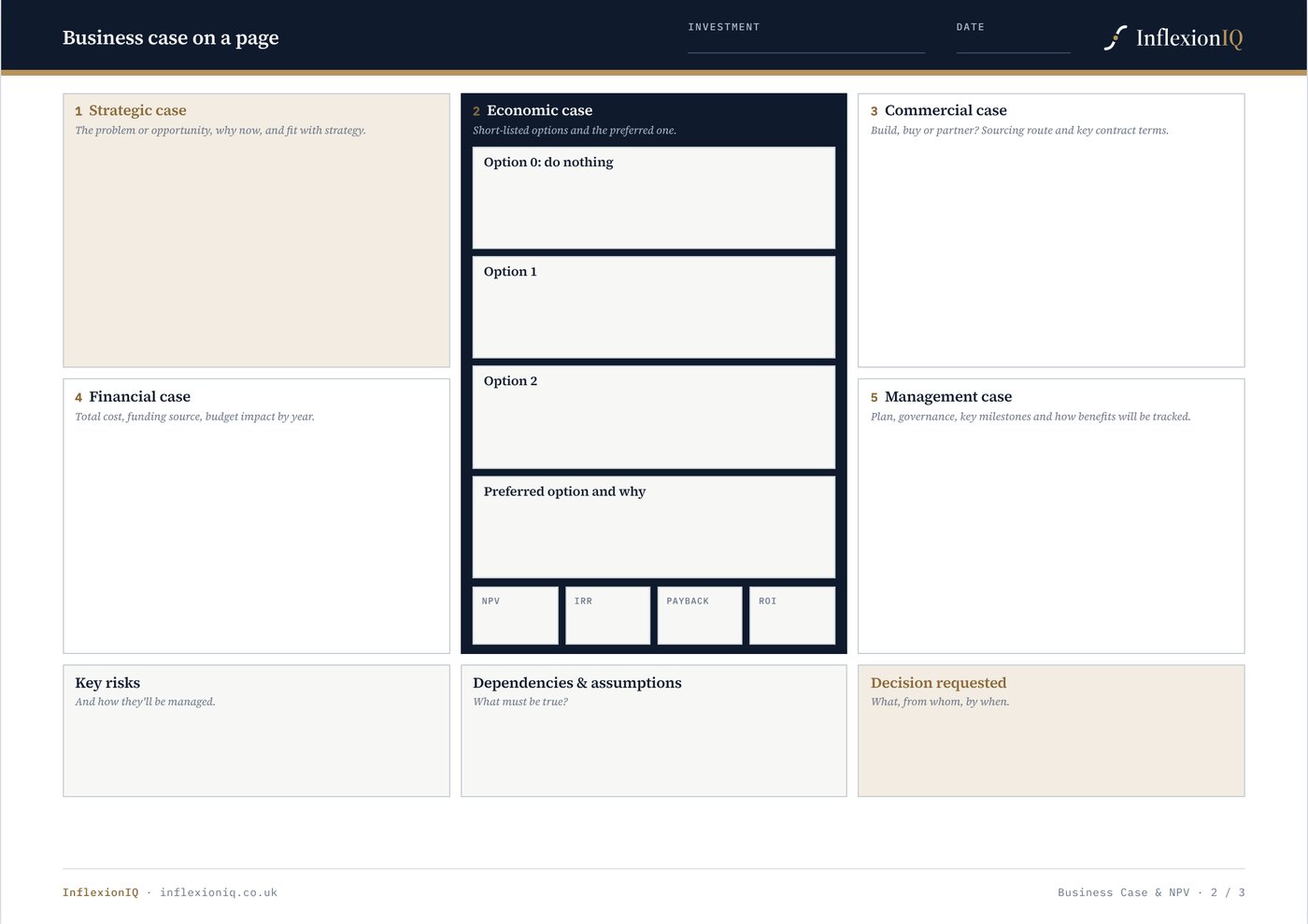
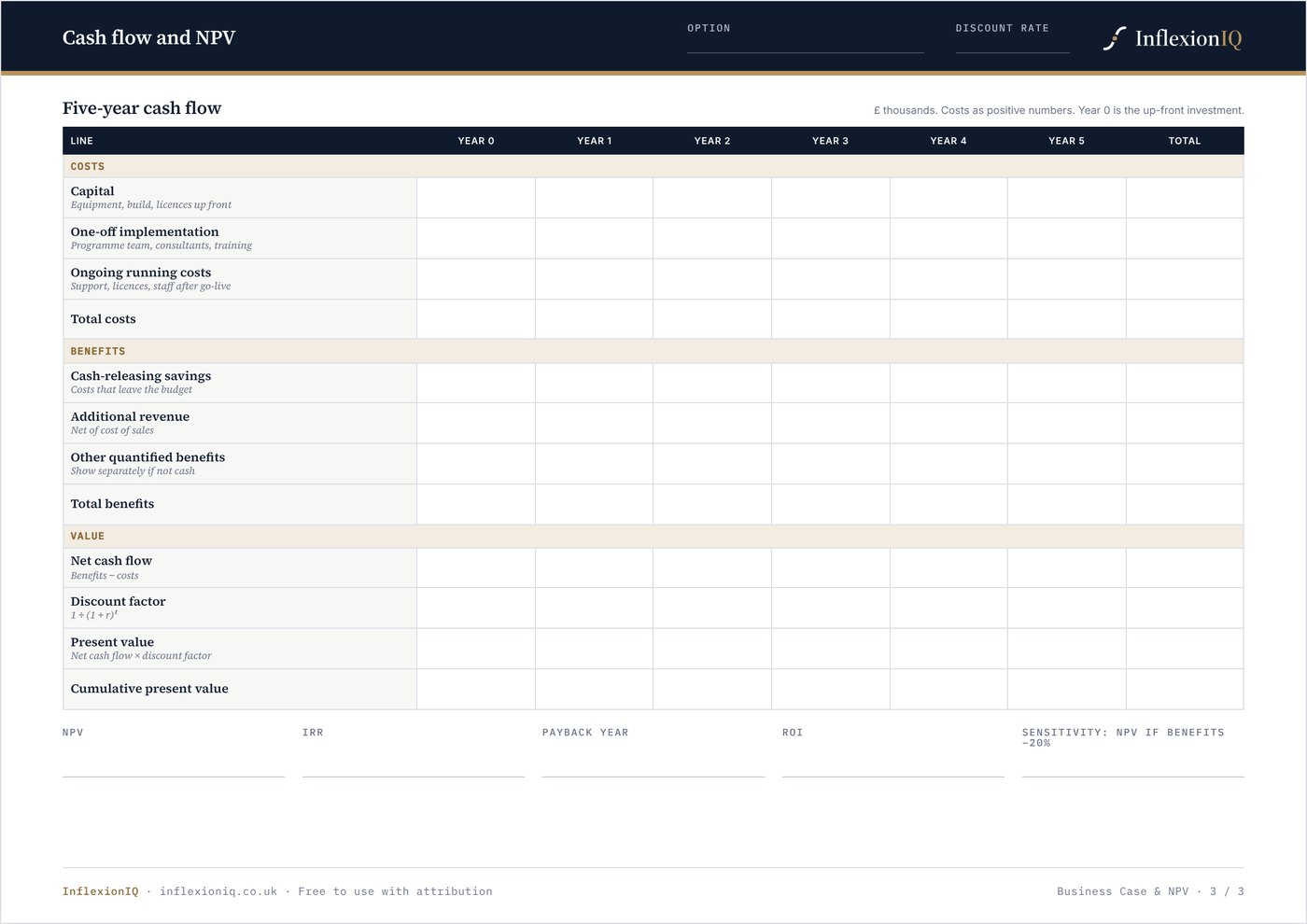
A business case template with a working calculator. The business case on a page covers the strategic, economic, commercial, financial and management case, with NPV, IRR and payback for the preferred option. A cash flow page sets out five years of costs and benefits. The Excel workbook models up to three options and calculates NPV, IRR and payback, with a side-by-side comparison.
Why use it
Good investments get rejected because the case is unclear, and weak ones get approved because nobody compared the options. A consistent structure and a transparent model make the decision faster and easier to defend.
How to use it
- Describe the problem and the outcome you need, in business terms, before naming any solution.
- Long-list the options, then short-list three or four, always including do nothing or do minimum.
- Model each option in the Excel workbook over the same five years and the same discount rate. Be conservative on benefits and ramp them up realistically.
- Test the preferred option: what happens if benefits come in 20% lower or a year late?
- Write it up on the one-page business case, with the cash flow page behind it, and name an owner for delivery and for each benefit.
Try it here
Change the numbers to see NPV, IRR and payback. It starts with the lender's Option 2: £1.2m up front, £600k a year of benefits.
Nothing you enter here leaves your browser. Download the template to keep your work.
When it helps
- Asking a board or investment committee for funding
- Comparing options for a transformation or technology investment
- Re-baselining a programme whose costs or benefits have moved
- Testing whether an idea is worth taking further
What is inside
- A guide to writing a business case decision-makers can act on
- A business case on a page, from strategic case to delivery
- A five-year cash flow and NPV page
- An Excel model for three options with NPV, IRR and payback
- A comparison sheet that updates as you change the numbers
Worked example
Three options went to the board. All figures are over four years at a 10% discount rate.
| Option 0: do nothing | Cost-to-income keeps rising and broker share keeps falling. This is the baseline. |
|---|---|
| Option 1: hire 25 more processors | Faster decisions, but adds £1m a year in cost. NPV is negative. |
| Option 2: AI document checks and a broker portal | Invest £1.2m. Saves £450k a year and earns £150k a year of extra margin from more broker cases. NPV £700k, IRR about 35%, payback in year 2. |
| Sensitivity | Option 2 still has a positive NPV if benefits are 20% lower (£320k), or arrive a year late (£530k). |
| Recommendation | Option 2, with a gate after the pilot to check accuracy and decision times. |
What happened next. The board approved Option 2. The pilot gate went straight into the RAID log and the benefits tracker.
Preview
Questions
What discount rate should I use for NPV?
Use your organisation's cost of capital or hurdle rate. Your finance team will usually have one. The UK public sector uses 3.5% under the HM Treasury Green Book. Test the result at a higher and lower rate too.
Why compare options rather than just one proposal?
A business case with one option invites a yes or no. Comparing it with doing nothing and at least one alternative shows the decision-maker why this option is the best use of the money.
Rate and review
How useful was this template?
Your rating and comments help me improve the template and decide what to build next. It takes less than a minute.
Thank you.
Your feedback has been sent. If you have got another minute, share the template with someone who'd find it useful.
More templates
All templates →
2x2 Prioritisation Matrix
Score value and effort against agreed criteria, plot the results, and make the hard calls the chart makes visible. PowerPointExcelPDFView and download →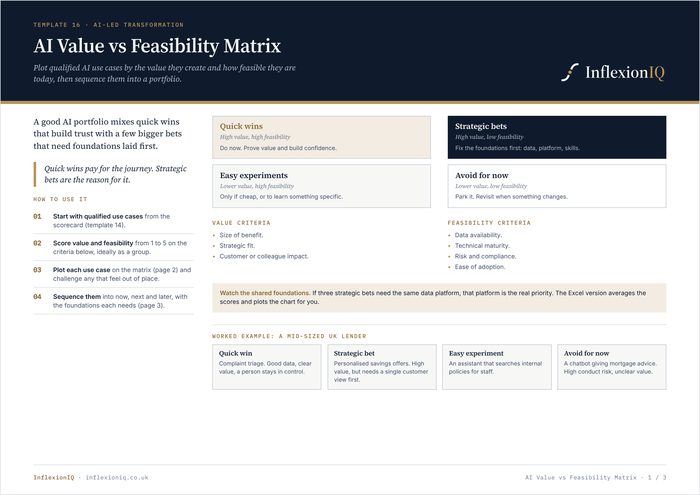
AI Value vs Feasibility Matrix
Plot qualified AI use cases by the value they create and how feasible they are today, then sequence them into a portfolio. ExcelPowerPointPDFView and download →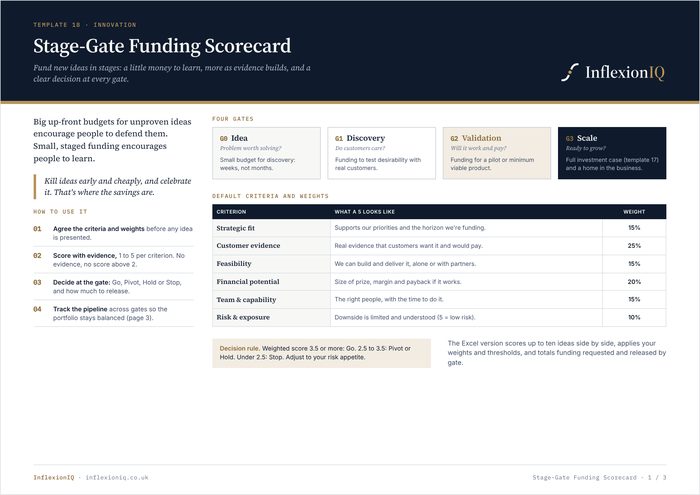
Stage-Gate Funding Scorecard
Fund new ideas in stages, with a little money to learn, more as evidence builds, and a clear decision at every gate. PowerPointExcelPDFView and download →Need something different? Request a template →